
For twenty years, investors have valued SaaS companies the same way: recurring revenue, growth, gross margin, retention. ARR was the headline number, and it worked, because software that customers renewed every year was expensive to build and hard to copy. Revenue was a fair stand-in for what had been built.
Forget about the ARR.
Revenue still matters, but it no longer tells you what you’re buying. A small team can now ship in months what used to take years, and many “AI companies” rent the hardest part of their product from a model vendor.
Two companies can show you the same numbers: $5M in recurring revenue, doubling every year, 75% gross margins, and a deck that says “AI-powered.” One has spent years building something its customers can’t easily leave. The other is a well-designed screen on top of someone else’s model, and a funded competitor could rebuild it in a few months.
The spreadsheet can’t tell them apart. Financial diligence confirms the revenue is real, but not whether the company built what it’s selling, or what you inherit when you invest. Before a term sheet you rarely get to read the code, either. The five questions below separate the two companies, and you can ask all of them in one session with management.
The five questions
Where does the advantage live?
- Why it matters
- Every company needs something a competitor can’t simply buy. In an AI company, that advantage lives in one of four places: the model, the data, the workflow customers have built around the product, or distribution (the customers and channels the company already has). Ask this first, because it decides how you read every other answer. A thin AI layer on top of a real network or workflow is fine, even healthy, because the company can switch model vendors cheaply. A company whose whole story is “proprietary AI” has to show you the AI.
- A good answer
- Names one or two of the four and explains why a well-funded competitor couldn’t buy or copy them within a year.
- Ask to see
- The thing they named. For a model: how it’s trained, how it’s tested, and what improved in the last version. For data: where it comes from and how it grows. For workflow: a customer using it live. For distribution: the channel agreements and how new customers arrive.
- Red flag
- The advantage is “our AI,” and the AI turns out to be a vendor’s public model plus a well-written set of instructions. That can be good product work. It isn’t intellectual property, and it shouldn’t be priced as a platform.
What happens if the model vendor changes the deal?
- Why it matters
- Most AI companies rent their models from a few large vendors. Those vendors change prices, retire models and rewrite terms on their own schedule, so part of the company’s margin and roadmap sits in someone else’s hands.
- A good answer
- They’ve switched models before, or can show the product running on a second one. They track AI usage costs per customer and know which customers would become unprofitable if prices doubled.
- Ask to see
- AI usage cost by customer for recent months, the pricing and termination terms in the main vendor contract, and the product running on an alternative model.
- Red flag
- ”We’re model-agnostic” with nothing to show for it, or no one can say what AI costs per customer.
Whose data is it, and can they prove it?
- Why it matters
- When you invest, you inherit the company’s data obligations. For a company that trains its own models, that includes where the training data came from. Most growth companies don’t train models. For them the exposure is the customer data they hold and pass to AI vendors: who sees it, under what agreement, and with what permission from the people it describes. In healthcare, financial services or anything that touches consumers, this is often the largest risk in the deal, and it rarely appears in the deck.
- A good answer
- They can list the data that matters, where each set came from, what gives them the right to use it, and which vendors see it under which agreements. Those rights survive a change of control.
- Ask to see
- The data inventory, the agreement with each AI vendor that sees customer data, and how permission is recorded for one real record.
- Red flag
- The data is called the moat, but no one can show where it came from or that the company is allowed to use it. Or customer data reaches an AI vendor with no agreement in place.
Who could change it if the builder left?
- Why it matters
- In young AI companies the core system is often understood by one or two people. Headcount won’t show you this. If those people leave when their shares vest, the product can stall while revenue keeps arriving for a while, which hides the problem.
- A good answer
- More than one person has changed the core system in the last six months, and the steps are written down well enough for a new engineer to follow.
- Ask to see
- The write-up for the last significant change to the core system, and who made the change.
- Red flag
- One name answers every technical question, or the documentation has never been used by anyone except the person who wrote it.
Can the AI cause harm, and would they know?
- Why it matters
- The first four questions ask whether the AI is valuable and defensible. This one asks whether it can hurt a customer, the people the customer serves, or the company itself. When AI output reaches people directly, especially in a regulated business, one bad answer can cost more than the feature earns.
- A good answer
- Where a wrong answer is costly, the AI is held to answers someone has reviewed, or a person checks before anything goes out. Errors are measured, and someone looks at the numbers.
- Ask to see
- Last month’s error or override rate, and one case where a person caught something the AI got wrong.
- Red flag
- Assurance without measurement. “Our model doesn’t hallucinate” is not a control.
The basics still matter
Fast-moving AI companies, often built with AI coding tools, are where ordinary controls slip: backups no one has tried to restore, open-source libraries years out of date, an incident plan that has never been rehearsed. These gaps have nothing to do with AI. They are still serious, and they’re easy to miss when every conversation is about the model.
Weigh what you hear
Something said in the meeting counts for less than something shown on screen, and both count for less than a document sent afterwards. When an answer sounds polished but not operational, ask “can you show me?” Teams that run their systems well can usually show you in two clicks. The company’s own decks help too: where a claim changes between the banker deck and the board deck, ask about it neutrally.
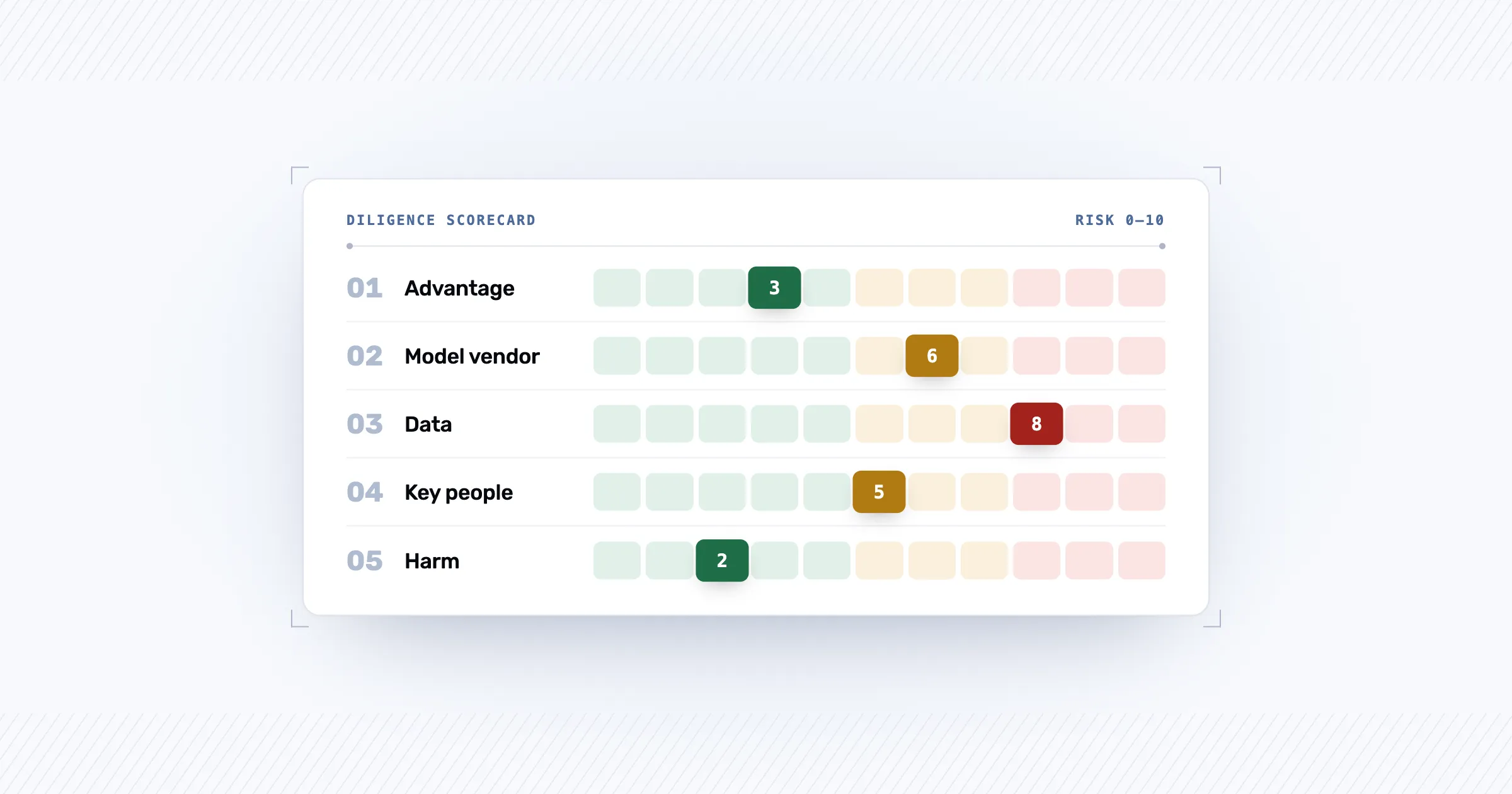
The scorecard
Score each question from 0 (low risk) to 10 (high risk).
| Question | Low risk looks like | High risk looks like |
|---|---|---|
| 1. Advantage | A named network, dataset or workflow a funded competitor couldn’t copy within a year | “Our AI,” which turns out to be a vendor’s model and a set of instructions |
| 2. Model vendor | Has switched, or can show a second model; AI cost tracked per customer | One vendor, no tested alternative, AI cost per customer unknown |
| 3. Data | Sources, rights and vendor agreements on record; rights survive a sale | Data called the moat with no proof of rights; customer data at vendors without agreements |
| 4. Key people | Several people have changed the core system; the steps are written down | One person; documentation no one else has used |
| 5. Harm | Reviewed answers where it matters; errors measured | Assurances, no measurement |
What to do with the scores
A score only matters if it changes something. For a lead investor in a growth round, these are the levers:
- A pre-close condition for a high score that can be fixed before closing.
- A 100-day commitment with an owner and a date, for one that can’t.
- Board reporting on the one or two risks that matter most, so they stay visible after the money arrives.
- A lower price, or a pass, when no condition or commitment fixes the risk.
Your co-investors will ask about AI risk too. The best answer is the scorecard itself: each risk, its score, what you saw, and what the company has committed to fix. That is more convincing than “we did technical diligence,” and it means the lead and the co-investors are looking at the same picture.
The point
Every AI deal should end one of two ways: you walk away knowing why, or you close knowing what you bought. Good diligence makes the price and the terms match what’s actually there, and it doesn’t have to slow the deal down.