
You’ve probably used ChatGPT. Maybe you’ve asked it to rewrite an email, summarize a document, or explain something confusing. That’s great, but that’s not an AI agent.
The term “AI agent” is everywhere right now. Vendors are slapping it on chatbots, autocomplete features, and basic search tools. The word has been drained of meaning. But behind the noise, operators are starting to deploy AI that handles real operational work: bookkeeping, reconciliation, compliance. If you run a business, understanding what an AI agent actually is changes what you expect from your software.
Start with what you already know
Think about the software you use every day. Your accounting system, your CRM, your email. All of it works the same basic way: you tell it what to do, and it does it. You click “send.” You click “post.” You enter the data, review the output, and approve the result.
That’s the model we’ve lived with for decades. Software handles the grunt work, but a human makes every decision and pulls every trigger.
AI tools like ChatGPT changed part of this. You can ask it to draft something, and it drafts it. But you still read the draft, decide if it’s right, and hit send yourself. ChatGPT is a very smart assistant, but it’s still waiting for you to act.
An AI agent doesn’t wait.
The line that matters
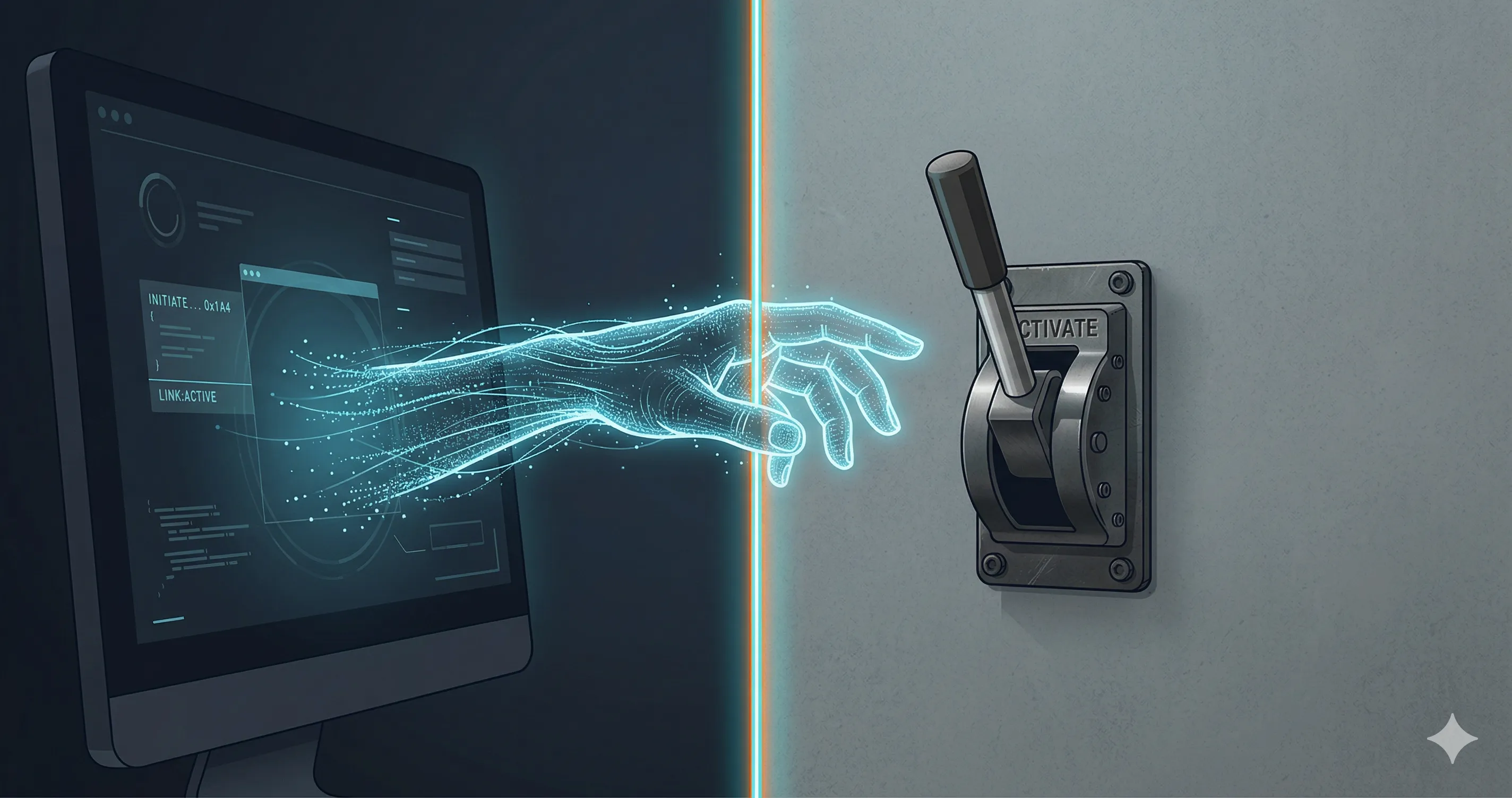
The simplest definition: an AI agent is software that makes decisions and takes action on real systems, without a human in the execution loop.
That last part is what matters. A copilot suggests; you act. An agent acts. The moment software goes from recommending something to actually doing it: posting the journal entry, sending the invoice, changing an access permission. That’s the line from tool to agent.
Three things make something an agent, and all three have to be true:
It decides what to do, not just how. An agent doesn’t wait for you to click “approve” on every action. It evaluates the situation, picks the right move, and executes. You set the boundaries ahead of time; the agent operates within them.
It changes real things. An agent writes to databases, sends emails, moves money, modifies records. Its actions have consequences that outlast the conversation. If the only output is text on a screen for you to read, you have an advisor, not an agent.
It uses judgment. An agent doesn’t follow a fixed script. It reasons about what to do. Given the same situation twice, it might act differently depending on context. That’s different from a Zapier automation that fires the same way every time a form is submitted. An automation follows a rule. An agent thinks about what the rule should be.
From tool to agent
These stages describe how the same software matures alongside your business, not four categories to pick from.
Stage one: tool. You trigger it, it executes. A spreadsheet formula. A report generator. You set it up; it calculates.
Stage two: copilot. It starts suggesting actions for you to review. Draft this email. Categorize this expense. You’re still making every call, but you’re making them faster.
Stage three: supervised agent. You’ve been approving the same routine journal entries for three months straight. The AI starts posting those automatically and only flags the exceptions: an unusual amount, a new vendor, a category it hasn’t seen before. You’ve gone from doing the work to reviewing the work.
Stage four: autonomous agent. Six months in, the system manages your accounts payable within the parameters you’ve defined. It processes routine compliance filings. You check in weekly, not daily. You’re managing outcomes, not transactions.
You don’t jump to stage four. You earn your way there. Each stage builds the trust and the track record for the next one. What makes it safe to move from one stage to the next is governance: the rules, checks, and audit trails that let you loosen your grip with confidence.
The math at a 30-person company
If you’re running a 30-person company, you don’t have a finance team or a dedicated IT department. You might be the CEO and the CFO. You’re spending $1,200–3,200 a month on bookkeeping alone, and every mistake hits harder because there are fewer people to catch it.
That’s exactly why AI agents are so appealing. You can’t always hire another person to handle the growing workload, but you can deploy software that handles it autonomously. An agent that processes invoices, reconciles accounts, or manages routine compliance tasks can free you up to focus on the work only you can do.
The problem is that the same autonomy that makes agents useful is what makes them risky.
When a copilot suggests a wrong journal entry, your accountant catches it before it’s posted. When an agent posts a wrong journal entry, it’s already in the ledger. There’s no human standing between the decision and the consequence.
That risk doesn’t argue for avoiding agents, only for running them with the right safeguards in place.
The governance question
Think of it this way: you wouldn’t hire an employee on day one and hand them the keys to your bank account. You’d start them with clear boundaries, require approvals on everything, and expand their authority as they prove themselves.
AI agents work the same way. You don’t start with full autonomy and bolt on controls after something goes wrong. You start with everything supervised, every action reviewed and every decision approved, and loosen the reins as you build trust. The agent earns its autonomy the same way a new hire does.
Governance is what lets agents speed up. The rules you set on day one are the same rules that let you confidently step back on day ninety. Without them, you’ll never be comfortable letting go. With them, the shift from “review everything” to “review exceptions” happens on its own. Instead of checking every transaction, you’re reviewing the 5% that actually need your judgment. That’s the shift from doing the work to managing the work.
What an agent is not
The market is full of things calling themselves “agents” that aren’t:
A chatbot isn’t an agent. It generates text for you to read. It doesn’t touch your systems or take actions with real consequences.
A copilot isn’t an agent. It augments your decision-making, but you still decide. GitHub Copilot suggests code; the developer accepts or rejects it.
A workflow automation isn’t an agent. If you can write the entire logic as an if/then statement, it’s automation. Agents handle the situations where the right decision isn’t predetermined.
A recommendation engine isn’t an agent. Your bank’s fraud detection is. It doesn’t ask permission before blocking a suspicious charge; it acts, then tells you. That’s an agent, and you’re glad it didn’t wait for approval.
An AI model isn’t an agent. ChatGPT, Claude, Gemini: those are the intelligence layer. An agent is what happens when you connect that intelligence to real tools, give it goals, and let it act. The model is the brain. The agent is the brain plus the hands.
What’s next
You don’t have to go from zero to autonomous overnight. If you’re getting value from copilots today, with ChatGPT drafting your emails or an AI assistant helping with bookkeeping, that’s the right place to be.
But watch what happens next. Your tools are getting more autonomous whether you ask them to or not. The copilot will start asking “should I just do this for you?” And when it does, you’ll want to already know what governance looks like.
The right approach starts with an AI that checks with you on everything. Over time, as it proves itself on the routine stuff, you let it handle more. A few months in, it’s posting your standard journal entries without asking. A year in, it’s managing your entire AP workflow. But it started where you were comfortable, not where a vendor wanted you to be.
At Diorthos, we make Inkstamp, an AI-native ERP and accounting system of record built for operators scaling beyond QuickBooks. AI proposes actions, your rules check them, and nothing touches your books until it’s been verified. You start fully supervised and unlock autonomy as trust builds. If you’re thinking about how AI agents fit into your business, it starts with a conversation.